


Electric scissor lifts need dependable charging systems to support repeated lifting cycles and demanding working environments. Standard charging configurations may not meet every machine’s requirements for power output, cooling, and installation space. Custom engineering allows OEMs to develop charging systems that fit their battery specifications and operating conditions.
Charging Requirements for Electric Scissor Lifts
Charging system design starts with the battery and the lift’s operating profile. Engineers need to confirm nominal voltage, battery capacity, chemistry, maximum charging current, and target charging time before selecting a charger.
The installation environment also matters. Limited chassis space, high ambient temperatures, vibration, dust, and moisture can affect charger selection and reliability. Available AC input power must support the required charging load without exceeding site electrical limits.
Defining these requirements early establishes the electrical, thermal, and mechanical parameters for the charging system.
High Power Charging System Design
Higher charging power can shorten charging time and reduce equipment downtime, provided the battery can safely accept the required current. The goal is to deliver sufficient continuous power without compromising battery safety or charger reliability.
Matching Output Power to Battery Requirements
Charger output must match the battery voltage, capacity, chemistry, and required charging time. Lead acid and lithium batteries require different charging profiles, so the charger must follow the battery manufacturer’s specifications and BMS limits.
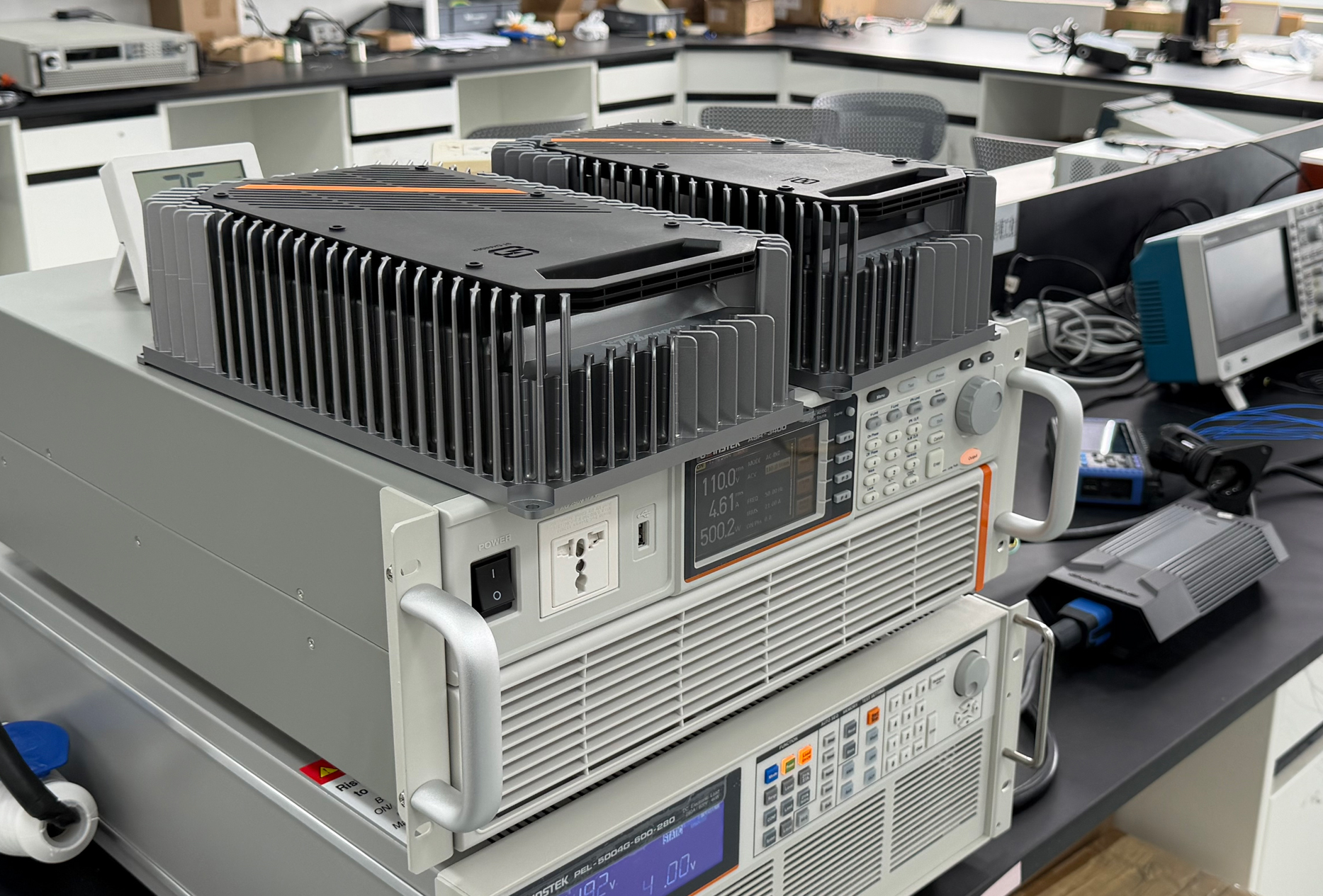
ST Charger’s onboard charger range offers 600W to 3,000W output, up to 95% conversion efficiency, and IP67 protection. The appropriate configuration depends on the lift’s battery specifications and operating conditions.
Maintaining Power Conversion Efficiency
Conversion losses turn part of the input energy into heat. Higher efficiency reduces these losses, helping limit thermal stress and improve energy utilization during repeated charging cycles.
Custom power design should consider switching components, circuit layout, operating range, and continuous output requirements. Efficiency must be evaluated under representative conditions rather than relying only on a peak rating. This helps establish a practical balance between charging performance, component temperature, and system size.
Thermal Management for High Power Charging
As output power increases, effective heat dissipation becomes essential. A charger installed in a confined chassis may experience restricted airflow, especially when operating in hot environments or delivering sustained high current.
Selecting the Cooling Method
Passive cooling avoids moving parts and can reduce maintenance requirements, but it depends on sufficient surface area and suitable airflow. Fan assisted cooling can remove more heat from compact, high power systems, although fan reliability, dust accumulation, and maintenance access must be considered.
The appropriate method depends on power output, ambient temperature, installation space, and environmental exposure. Thermal testing should confirm that component temperatures remain within their specified limits during sustained charging.
Integrating Thermal Design With the Enclosure
Cooling performance depends on more than the heat sink alone. The enclosure, component placement, airflow path, and heat transfer interfaces must work together to prevent localized overheating.
A sealed enclosure can protect against dust and moisture, but it also affects heat dissipation. Engineers must balance enclosure protection with cooling requirements. ST Charger’s company technology supports the evaluation of thermal design and charging control for customized applications.
Customization and System Integration
A charging system must fit both the battery and the physical architecture of the lift. Customization addresses electrical compatibility, communication, mounting, and environmental requirements that a standard configuration may not fully accommodate.
Configuring Battery Communication and Protection
For lithium battery systems, communication between the charger and BMS can help coordinate charging limits, temperature conditions, and fault responses. Depending on the selected hardware and control architecture, interfaces such as CAN, CANopen, and UART may be used.
The design should define how the charger responds when the BMS restricts current or requests charging to stop. Communication compatibility, fault handling, and shutdown behavior must be verified with the actual battery and controller.
Adapting the Charger to Equipment Constraints
Mechanical integration involves mounting dimensions, connector placement, cable routing, vibration resistance, and enclosure protection. These factors are especially important when installation space is limited or the lift operates in exposed environments.
The required ingress protection rating should match the expected conditions. An IP rating does not, by itself, guarantee resistance to every chemical, impact, or temperature exposure. Custom enclosure and mounting decisions should therefore reflect the equipment’s actual operating environment.
Validating Charging System Performance
Before deployment, the complete charging system should be tested under representative electrical and environmental conditions. Validation should cover continuous output power, voltage and current regulation, conversion efficiency, temperature rise, BMS communication, and fault handling.
Testing should use the intended battery configuration and installation arrangement. Where the design includes customized cooling, connectors, or control functions, those elements should be evaluated as part of the complete system. Applicable electrical safety and market compliance requirements must also be confirmed for the target application.
Conclusion
Custom charging system design helps electric scissor lift manufacturers balance high power output, thermal performance, and equipment integration. Defining battery requirements and operating conditions early provides a foundation for a reliable charging solution.
For project specific requirements, contacter ST Charger to discuss battery specifications, target charging time, installation constraints, and cooling requirements.